
How Irish Small Businesses Should Think About AI in 2026
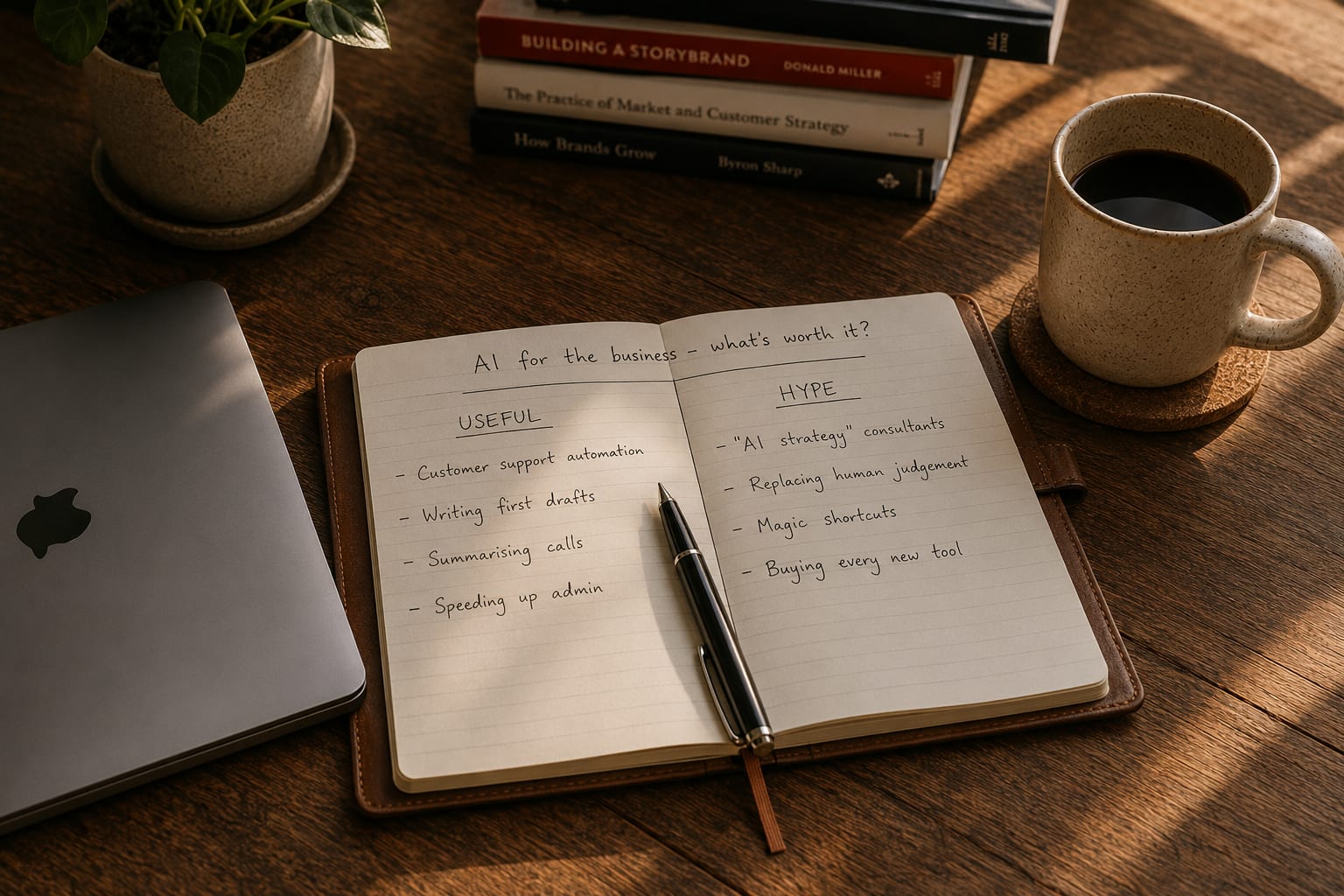
Quick answer. For most Irish small businesses, AI in 2026 is best used for three things: removing repetitive admin work, helping customers find answers without contacting staff, and helping staff produce content faster. Avoid expensive "AI strategy" projects until you've tried free or low-cost tools and seen what genuinely saves you time.
AI is the most loaded topic in small business right now. There's a hype camp telling you it's going to change everything, you need a strategy, and you should be investing five figures yesterday. There's a cynic camp telling you it's a fad, mostly useless for real businesses, and the people selling it don't believe in it themselves. Both are wrong, in different ways, and both can lead you into wasted money.
The honest version: AI is genuinely useful for a specific list of jobs, mostly less useful than its loudest advocates claim, and most of the real wins for Irish small businesses can be tested for free this week. Here's the practical guide.
The two camps you'll hear from, and why both are wrong
The hype camp talks about AI like it's an event happening to you. It's transformative, it's revolutionary, every business needs an AI strategy, those who don't act now will be left behind. The pitch usually ends with a five-figure consulting engagement.
The cynic camp says AI is overhyped, it makes things up, it's not actually useful, real work needs real humans, and small businesses can safely ignore the whole thing. The pitch usually ends with "carry on doing what you're doing."
Neither is right. AI is a tool. Like any tool, it's transformative in the right hands for the right jobs, and useless or worse in the wrong hands for the wrong jobs. The interesting question isn't "is AI useful?" It's "what specifically would AI be useful for, in your specific business?"
Where AI genuinely helps right now
The areas where AI consistently delivers real, measurable value for Irish small businesses.
Repetitive admin. Email triage, scheduling, data entry from documents, generating reports, processing invoices. We covered this in detail in our piece on workflow automation. AI extends what classic automation can do by adding judgement and reading capability.
24/7 FAQ deflection. A properly-trained chatbot answers the same questions your team answers ten times a day, freeing them for the questions that actually need human attention. We've covered this thoroughly in our chatbot guide.
Drafting first-draft content. Email replies, social media posts, product descriptions, blog post outlines, proposals. AI produces serviceable first drafts in seconds. The human edits, refines, and adds the bits AI can't (voice, specifics, judgement) in a fraction of the time it would take to write from scratch.
Document and data processing. Reading supplier invoices and extracting line items. Summarising long documents. Pulling key information from PDFs. Translating between languages. These were expensive engineering problems five years ago. Now they're a paragraph of code or even a no-code tool.
Lead qualification. A short conversational form-up-front that asks the right questions and routes serious leads to a human, freeing your team from sales calls that never had a chance.
Internal knowledge search. A staff-facing AI that reads your internal documentation, manuals, and policies and answers staff questions instantly. Particularly powerful for businesses with high staff turnover or distributed teams.
Where AI is still mostly hype
It's worth being equally specific about where to be sceptical.
"AI strategy" consulting for €10,000+. For a typical Irish SME, this is overkill. You don't need a strategy. You need to try the free tools, find what saves you time, and only then think about bigger investments. Anyone trying to sell a small business an "AI strategy" before they've used AI for anything is selling you a roadmap to a destination they don't understand.
Anything claiming to replace your sales team. AI can support sales (qualification, follow-up reminders, drafting outreach). It cannot do the actual selling for any real-money business-to-business sale. People buy from people they trust.
Predictive analytics with insufficient data. Most small businesses don't have enough data for predictive models to outperform "ask the owner what they think." If a vendor is offering you AI-driven predictions and you have less than tens of thousands of historical data points, the predictions won't be meaningful.
AI that promises certainty in genuinely uncertain decisions. "Our AI will tell you which customers will buy" or "Our AI knows what your competitors will do next" are sales pitches dressed up as software. Genuine uncertainty doesn't disappear because you bought a tool.
The free starting points worth trying this week
Before spending anything on AI, spend two hours with the free tools. You'll learn more about what's actually useful for your business than from any consultation.
ChatGPT free tier (chat.openai.com). The most familiar entry point. Free, capable, good general-purpose assistant.
Claude free tier (claude.ai). Often better at writing in a natural tone and following detailed instructions. Strong with longer documents.
Google Gemini (gemini.google.com). Tied into Google Workspace if you already use Gmail and Docs.
Practical things to try in your first hour: paste in three of your standard email replies and ask the AI to draft a fourth one in the same voice. Upload a recent contract and ask it to summarise the key terms. Ask it to draft a social media post about a recent piece of work. Get it to write a short blog post outline on a topic relevant to your customers.
Concrete examples by industry: a trades business can draft quote emails, summarise long supplier specifications, and generate standard cover letters for tenders. A hospitality business can draft menu descriptions, write social posts about specials, and translate guest information into other languages. A professional services firm can summarise long client documents, draft engagement letters, and generate first-pass proposals. A retail business can write product descriptions, draft staff training documents, and generate seasonal email campaigns.
When to pay for AI tools
The free tiers will take you a long way. You graduate to paid when:
The free tier limits become annoying. Usage caps, slower models, no access to the latest version. €20–€30/month per user for ChatGPT Plus or Claude Pro is usually worth it for any staff using AI daily.
You need integration with your existing tools. Plugins, browser extensions, API access for connecting AI into your CRM, support system, or website.
You need privacy guarantees. Free tiers of consumer AI tools sometimes use your conversations to train future models. Business and enterprise tiers come with proper Data Processing Agreements that exclude your data from training. Necessary for anything sensitive.
When to build custom AI for your business
The case for a custom build, rather than just buying a SaaS tool, is more limited than vendors suggest. It's the right call when:
The off-the-shelf tools can't be properly grounded in your specific business knowledge (the RAG approach covered in our chatbot post). You need real data privacy guarantees beyond what SaaS provides: for example, healthcare, legal, or financial data. You have a high-volume repetitive workflow with measurable value: the kind of thing where saving 10 seconds per occurrence adds up to hundreds of hours a year.
Custom builds typically start at €3,000–€8,000 for focused implementations, with monthly running costs in the €50–€300 range for AI API usage and hosting. We cover the typical engagement on our AI-Powered Solutions page.
GDPR considerations for AI use
If you're using AI in your business and personal data is involved, GDPR follows. The questions to ask: where does the data go (which country, which provider)? Are you sending personal data in your prompts? What's the AI provider's Data Processing Agreement status? Is the use covered by your existing privacy policy?
The Data Protection Commission has published specific guidance on AI use and has been active in this space. For full background, see our GDPR checklist for Irish small businesses.
Practical defaults: don't paste customer personal data into free consumer AI tools. Use business tiers with proper DPAs for any work involving personal data. Update your privacy policy to reflect AI use. Document your decisions.
How to get started without wasting money
A staged approach that consistently works for Irish SMEs:
Stage 1 (this week, €0): Try ChatGPT, Claude, and Gemini free tiers. Use them daily for two weeks. Notice what actually saves you time.
Stage 2 (next month, €20–€200/month): If specific tools are saving you time, upgrade to paid tiers. Try one or two AI-specific SaaS tools (e.g. an AI scheduling assistant, an AI email triage tool, a SaaS chatbot if you get the volume to justify it).
Stage 3 (3–6 months in, €3,000–€10,000 one-off): Only after you've proved the value of AI in your day-to-day work, and identified specific workflows where off-the-shelf doesn't quite fit, consider a custom build. By this stage you know exactly what you'd want it to do, which makes the build far more likely to succeed.
The owners who get the most from AI are the ones who started with the free tools and let their actual experience guide the spending decisions. The ones who started with a €15,000 strategy engagement are usually still trying to figure out what to do with the deliverables a year later.
The Irish-specific angle
Enterprise Ireland has been increasingly active around AI for SMEs, with grant funding available for businesses adopting or building AI tools as part of their growth plans. The Local Enterprise Office network often runs free AI workshops. Worth checking your local LEO for upcoming sessions. The good news is the same Irish business support structures that fund websites and digital transformation projects can also fund AI ones, if you qualify.
If you're not sure where to start with AI for your specific business, we'd happily talk it through: what you do, what's repetitive, what's slow, what's frustrating. From that conversation, we can usually point at the cheapest, highest-impact starting point, even if (as is often the case) the answer is "try this free tool for a fortnight before you spend anything." No commitment, no pressure, and no five-figure strategy engagement waiting at the end.
Frequently asked questions
Will AI replace small business staff?
For most roles, no. But it changes what the role looks like. Staff who use AI well become more valuable; staff who refuse to engage will be left behind.
How much should I spend on AI in 2026?
Start with €0. Most useful AI tools have free tiers. If you find specific tools saving you serious time, €20–€200/month per useful tool is normal. Custom AI builds start around €3,000–€8,000.
Is AI safe to use for business data?
It can be, but read the provider's data policy. Free tiers of consumer AI tools sometimes use your conversations to train models. Use business/enterprise tiers for anything sensitive.
Can AI help with GDPR compliance itself?
Indirectly. AI can help draft policies, analyse data flows, and respond to subject access requests. But you still need a human to verify and accept responsibility.
What's the easiest AI win for an Irish small business in 2026?
First-draft writing (emails, social, product descriptions) and FAQ chatbots. Both deliver measurable time savings quickly.
Not sure where to start with AI?
We'll talk through your business and recommend the cheapest, highest-impact starting point, including the cases where the answer is "try this free tool first." No commitment.
Start a project →
Share
LinkedIn