
Conversion Rate Optimisation for Irish Small Business Websites
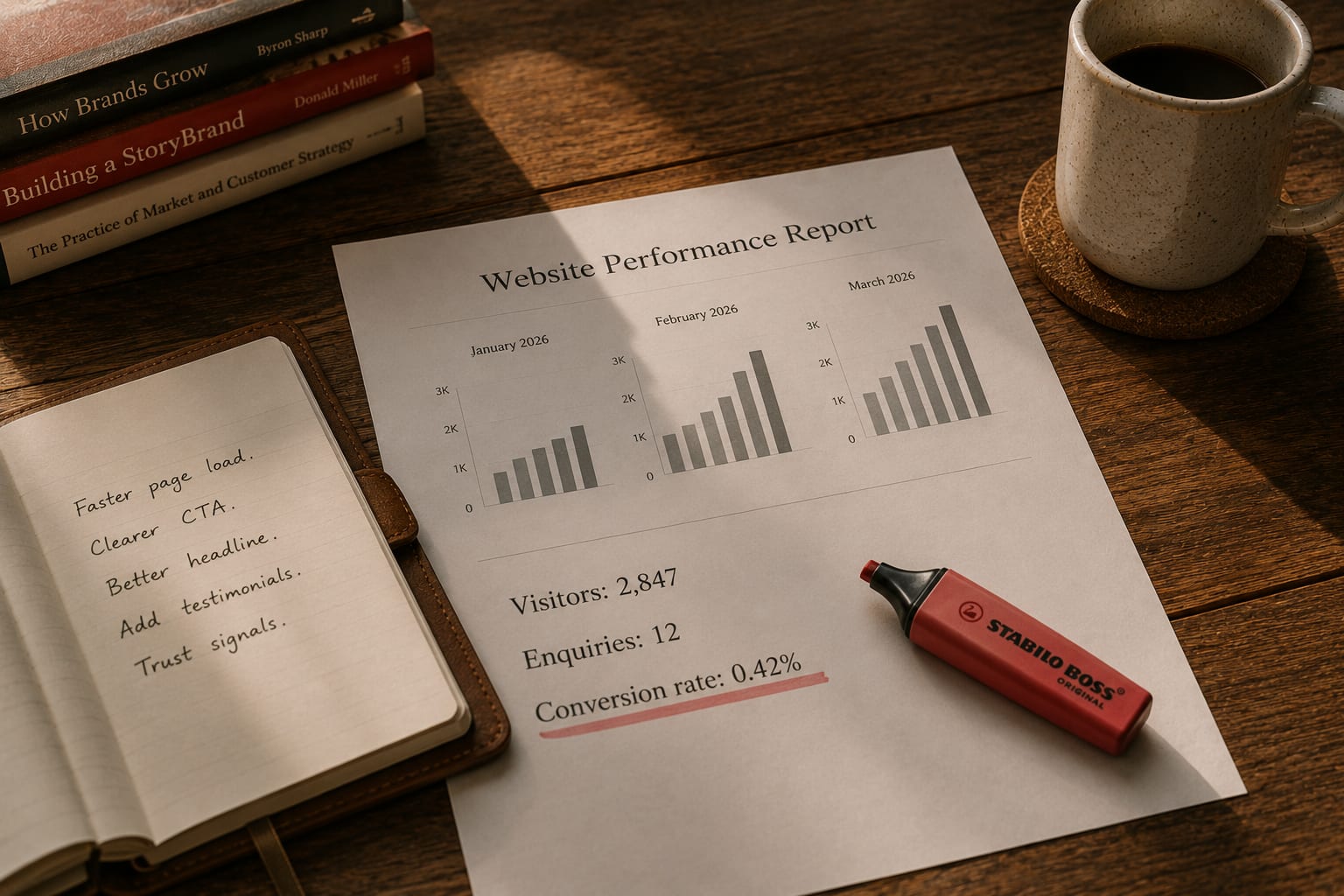
Quick answer. Most Irish small business websites convert at under 1%. With straightforward changes (clearer headlines, removing friction from forms, adding trust signals, and fixing slow load times) most sites can double their conversion rate within 3 months without spending a euro more on traffic.
Most owners spend more energy on traffic than on conversion, even though conversion is usually the cheaper win by a wide margin. Doubling visitors to your site is hard and expensive. Doubling the percentage who become customers is often free, faster, and lasts longer. This is the practical playbook for the second one.
What "conversion" actually means for your business
Conversion isn't just sales. For most Irish small businesses, it's the next meaningful step a visitor takes: a contact form submission, a phone call, a quote request, a booking, a brochure download. The first move toward becoming a customer.
Before you measure anything, define what counts. A trades business might count phone calls and quote form submissions. A consultancy might count discovery-call bookings. An e-commerce site counts purchases. A clinic counts appointment requests. Be specific. Vague goals don't get optimised.
The maths of why CRO usually beats more traffic
Consider three scenarios. Site A gets 100 visitors a month at a 1% conversion rate, so one enquiry per month. To double that, Site A could either pay to double traffic (Google Ads at perhaps €15–€40 per click in competitive Irish markets, ongoing every month, every year), or fix the site to convert at 2%, same one-off effort, no recurring cost.
The CRO route gets you to the same place faster, and once the improvements are in, they compound forever. Every future visitor benefits from them. The traffic-buying route stops the moment you stop paying. For most small businesses with a steady trickle of organic visitors, CRO is the rational first move.
The eight changes that typically lift conversion the most
1. A clearer, sharper headline
Most small business homepages have a vague headline. "Welcome to [Company Name]" or "Quality services in Dublin since 2008." Neither tells a visitor what you do, who you do it for, or why they should care.
A good headline answers: what is this, who is it for, what's the benefit. "Custom kitchens for Dublin homeowners, designed and installed in 6 weeks" beats "Quality kitchens since 1998." Spend a week getting your headline right. Test it against the question "would a stranger know exactly what we do from this one line?"
2. Fewer fields on the contact or quote form
Every field on a form reduces submissions. The honest minimum is name, email, and a short message field. Anything else makes people drop off. If you need phone number, ask for it. If you need budget, ask for it. But ask honestly: do you really need their company name, job title, and how they heard about you on the first contact? Probably not.
A typical pattern we see: a form goes from 9 fields to 4 and submissions roughly double overnight. The information you "lose" by removing fields you can ask for in the follow-up conversation.
3. Trust signals above the fold
People want to verify a real business is behind the website before they commit to filling in a form. Above the fold (the part of the page visible without scrolling) show evidence: a real photo of you or the team, real reviews with names and locations, years in business, recognisable client logos if you have them, or relevant credentials.
Generic stock photography and "trusted by professionals" without specifics actively reduce trust. Specific real evidence builds it.
4. A real call-to-action button
"Submit" is dead. "Send" is uninspiring. "Get a quote," "Book a free consultation," "Start your project," "Talk to us" all convert noticeably better. The button language should match what the visitor actually gets when they click.
The button should also be a real, contrasting colour that stands out from the page. Position matters: put it where the visitor is at the moment of decision, not buried at the bottom of long-scrolling pages.
5. Faster load times
Speed directly affects conversion. Industry data is consistent: every 100ms of page load improvement increases conversion by roughly 1–2%. A site that loads in two seconds will convert noticeably better than the same site loading in five.
The technical fixes (image optimisation, fewer scripts, modern hosting, sometimes a platform change) are covered in detail in our audit guide on outdated websites. Worth measuring with PageSpeed Insights and fixing the obvious offenders.
6. Mobile-first design
70%+ of Irish web traffic is mobile, but conversion is often lower on mobile than desktop because most sites were designed primarily for laptops. The signals: tap targets too small, text that requires zoom, forms that don't fit the screen, contact buttons that aren't reachable with one thumb.
Test your own site by opening it on your phone and trying to convert (fill out a form, ring the number, request a quote). If it takes more than two taps from the homepage to start, you're losing mobile visitors who can't be bothered.
7. Social proof at decision points
A testimonial next to the call-to-action button is more persuasive than a testimonial buried in a dedicated "Reviews" page nobody visits. The right place for a quote from a happy customer is right before you ask the visitor to commit, not three scrolls later.
Concrete results convert better than generic praise. "Aylward Solutions doubled our enquiry rate within three months" beats "great service, would recommend." Names, faces, and specifics build trust; vague endorsements don't.
8. Removing distractions
Less converts more. Every additional thing on the page splits the visitor's attention. The biggest distraction offenders: pop-ups (especially intrusive ones), sidebars on every page, navigation menus with twenty items, sliding carousels nobody reads past the first slide, social media feed widgets, and "as featured in" logos that don't mean anything to anyone.
For the page you actually want people to convert on, ruthlessly remove anything that isn't either content related to the conversion, evidence of trust, or the action itself.
How to measure conversion properly
Most small businesses guess at their conversion rate. Set up Google Analytics 4 properly so you actually know. The minimum: define your conversion events (form submissions, phone clicks, booking completions), tag them in GA4, and check them weekly.
For phone-heavy businesses, also track tel: link clicks as conversions. Visitors who click the phone number on mobile are extremely high intent. For e-commerce, GA4's built-in e-commerce tracking gives you transaction-level data. For lead-gen, count form submissions to your CRM and call tracking if you can.
Without measurement, optimisation is guesswork. With it, every change is testable.
A/B testing: when it's worth it and when it isn't
A/B testing, running two variants of a page simultaneously and measuring which converts better, works well for sites with substantial traffic. The rough rule is you need 1,000+ visitors per variant per week to get statistically valid results within a reasonable timeframe. Most Irish small businesses don't have that much traffic.
For lower-traffic sites, the better approach is to make informed changes based on UX principles and measure the before/after impact over 4–8 weeks. Less mathematically rigorous, but practical and useful at small-business scale.
If you have over 5,000 visitors a month and want to test bigger changes (a new headline, a different CTA, restructured navigation), A/B testing tools like Google Optimize successor tools, VWO, or simple custom variant testing in GA4 can be worth the investment.
The CRO mistakes that cost Irish SMEs leads
The patterns that come up over and over.
Hiding pricing entirely. Visitors who can't find any pricing information often assume they can't afford you and leave. Either show ranges, show a starting price, or be honest about why you don't (custom scope, varied requirements) and give them an easy way to get a real number quickly. We covered the pricing-transparency angle in detail in our website cost guide.
Asking for too much in forms. Already covered, but it's the single most common preventable mistake.
Adding live chat that nobody monitors. A live chat widget that responds in 6 hours is worse than no chat. If you can't staff it (or pair it with a properly-grounded AI chatbot, which we cover in our chatbot guide), don't put it on the site.
Designing for design's sake. A beautiful site that doesn't convert is a portfolio piece, not a business asset. Visual polish matters, but only in service of clearer communication and easier conversion. If a design decision makes the site look nicer but the call-to-action less obvious, the design is wrong.
If you'd like a CRO audit of your own site (specific changes you could make, with rough estimates of likely impact) that's exactly the kind of thing we do on a first conversation. Send the URL and we'll come back with a plain-English summary of the easy wins.
Frequently asked questions
What's a good conversion rate for a small business website?
2–5% is solid for a service business. Under 1% suggests something's off. Over 5% usually means you've got it dialled or your traffic is very high-intent.
How long does it take to see conversion improvements?
Most well-targeted changes show results in 4–8 weeks if you have steady traffic.
Do I need a lot of traffic for CRO to work?
Some yes. You need enough visitors to measure changes. Under 500 visitors/month and conversion improvements are hard to measure statistically but still worth making.
What's the biggest mistake small businesses make on their site?
Trying to say everything to everyone. A site that's clear about who it's for and what it does converts better than one trying to be all things.
Can AI help with conversion optimisation?
Yes. AI can help analyse where visitors drop off, suggest copy improvements, and personalise content. We've built AI-driven conversion improvements for several Irish clients.
Send us your site for an honest CRO audit
We'll tell you, in plain English, what's costing you conversions and what's an easy win. No commitment, no pressure.
Start a project →
Share
LinkedIn