
Next.js vs WordPress: Which Is Right for Your Irish Business?
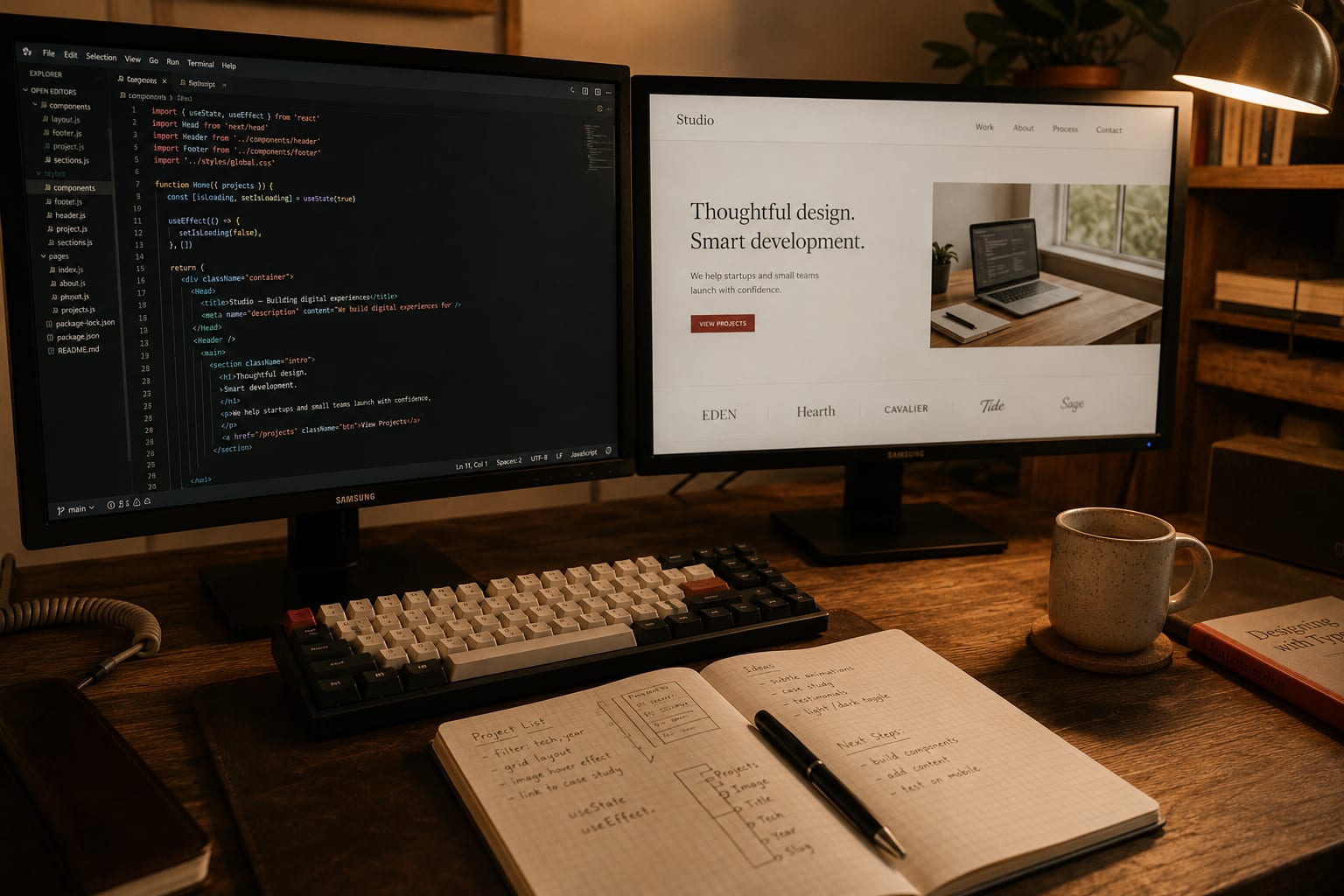
Quick answer. WordPress wins when the client needs to edit content regularly and the site is reasonably standard. Next.js wins on speed, security, SEO performance, and any site doing more than "pages and a blog." For most Irish small business marketing sites in 2026, modern Next.js with a headless CMS beats WordPress on every metric, but only if it's built properly.
Most articles comparing Next.js and WordPress are written by people with a stake in the answer. Agencies that build only WordPress argue for WordPress. Modern dev shops argue for Next.js. The honest answer involves trade-offs in both directions and a clear sense of what your specific situation actually needs. Here's the version without an agenda.
The honest summary
WordPress is the elder statesman: roughly 40% of all websites on the internet run on it, the plugin ecosystem is vast, every web developer in Ireland has built on it. The weaknesses are performance (without serious optimisation, it's slow by modern standards) and security (the plugin ecosystem is the main attack surface for small-business breaches).
Next.js is the modern React framework that's taken over the higher end of the web in the last five years. Faster, more secure, more SEO-friendly out of the box. The trade-off is that it requires more developer effort to make editor-friendly for non-technical staff, and the cost of doing it badly is higher than the cost of doing WordPress badly.
The middle ground, Next.js paired with a headless CMS like Sanity or Contentful, gets you most of the benefits of both. It's what most modern Irish small business sites should be using in 2026 if performance, SEO, and long-term maintainability matter.
Speed and Core Web Vitals
Speed is no longer optional. Google now uses Core Web Vitals as a ranking signal directly, and Irish consumer behaviour reflects what every market shows: slow sites lose visitors before the first scroll. A site loading in under two seconds on a 4G connection feels normal. Three seconds and you're losing a chunk of your audience. Five seconds and you've lost most of them.
Next.js produces fast sites by default. Server-side rendering or static generation, automatic code splitting, optimised image handling, modern image formats. These are baked in. A reasonably-built Next.js business site will score 90+ on PageSpeed Insights without heroic effort.
WordPress can be fast, but only with serious work. Caching plugins (WP Rocket, W3 Total Cache), image optimisation plugins (ShortPixel, Imagify), a fast host (Kinsta, WP Engine), a lightweight theme, and disciplined plugin selection. Even then, a typical heavy WordPress build with five plugins and a stock theme will score in the 30s and 40s on mobile PageSpeed.
For Irish SEO specifically, this matters. Local search is competitive, and a faster site genuinely outranks a slower one when other factors are close.
Security
The vast majority of hacked small Irish business websites we audit are running WordPress, and almost all of those breaches trace back to a plugin or an out-of-date core. WordPress itself is reasonably secure when patched. The problem is the plugin ecosystem: thousands of third-party plugins, varying quality, varying maintenance schedules, all running with significant privileges on your site.
Next.js sites have a much smaller attack surface. Most are statically generated (meaning what's served to the visitor is just HTML and CSS with no runnable code) or run on serverless functions with strict permissions. There are simply fewer ways in.
That said, Next.js isn't magic. A poorly-built Next.js site with insecure API endpoints, exposed environment variables, or unauthenticated database access can still be breached. The difference is that the platform doesn't push you toward those mistakes the way the WordPress plugin model does.
SEO
Both platforms can rank well. WordPress with Yoast or Rank Math handles the basics (titles, meta descriptions, schema, sitemaps) and millions of WordPress sites rank highly across every market. Next.js handles the same fundamentals natively and adds structural advantages on the technical side: Core Web Vitals scores, server-side rendering for crawlers, deeper control over meta and structured data.
In 2026, the SEO gap is widening in Next.js's favour because Google now weighs Core Web Vitals more heavily than it did when these conversations started in 2020. A well-built Next.js site has a meaningful structural advantage. A poorly-maintained WordPress site has an active disadvantage.
For content-heavy publishing where you're shipping multiple posts a week and the editor experience matters, WordPress still has the edge in workflow. For everything else, Next.js wins on technical SEO out of the box.
Editor experience for non-technical staff
This is where WordPress genuinely shines. The Gutenberg editor, while controversial among developers, is approachable for non-technical users. Most Irish business owners have used WordPress in some form. There's no learning curve.
Vanilla Next.js has no editor at all. Content lives in code, which means non-technical staff can't update it. That's a non-starter for businesses that want to add blog posts, change copy, or swap photos without contacting a developer.
The solution is a headless CMS: Sanity, Contentful, Strapi, or DatoCMS. The CMS provides the editor interface; Next.js renders the site. Non-technical staff get a clean, modern editor (often nicer than WordPress in practice); the site keeps Next.js performance and security. This combination is what most modern small business builds should be using.
Cost
WordPress is cheaper to build upfront. More templates exist, more developers know it, the average build comes in lower. A typical Irish small business WordPress site might cost €2,500–€5,000 for the same scope a Next.js + headless CMS build would cost €4,000–€8,000.
Long-term costs flip the comparison. WordPress needs ongoing maintenance: core updates, plugin updates, security patches, the occasional plugin breaking after an update. Either you pay a care plan (€50–€200/month) or you take the risk yourself. Next.js sites need much less ongoing care. The platform updates rarely affect production sites, there are no plugins to break, and hosting on platforms like Vercel or Cloudflare is cheap and stable.
Three-year total cost for a typical small business site, including hosting and maintenance, tends to land in roughly the same place for both. Five-year cost favours Next.js noticeably. For a real budget breakdown on website costs more generally, see our honest guide to website costs in Ireland.
When to pick WordPress
WordPress is the right answer for several specific situations.
Content-heavy publishing. Multiple posts per week by non-technical staff, with editorial workflow needs (drafts, scheduling, multi-author). Gutenberg handles this well and the plugin ecosystem supports it deeply.
E-commerce on WooCommerce. If WooCommerce specifically fits your product catalogue and customer model, WordPress is the natural choice. (For larger e-commerce, Shopify is increasingly the better answer regardless.)
Tight budget with standard requirements. A 5–10 page brochure site with a contact form, on a budget under €3,000. WordPress can deliver here cheaply.
Existing WordPress investment. If you've already got a meaningful WordPress site with custom plugins or workflows, the migration cost may outweigh the benefits.
When to pick Next.js
Next.js (typically paired with a headless CMS) is the right answer for most other scenarios.
Marketing sites where speed and conversion matter. Every 100ms of speed improvement increases conversion measurably. For lead-gen sites, the structural performance edge matters financially.
Custom features and integrations. Anything beyond standard pages and blog (bespoke calculators, integrations with CRMs, custom dashboards, gated content) is easier to build cleanly in Next.js than to bolt onto WordPress.
High-traffic sites where performance affects revenue. Hospitality, e-commerce, anything where seconds of latency cost real money.
Sites that need to scale. Adding traffic to a Next.js site is cheap; adding traffic to a WordPress site usually means upgrading hosting tiers.
Anything mission-critical. Where downtime, security breaches, or slow page loads have material business impact.
The hybrid: Next.js plus headless CMS
The recommendation we make most often. Next.js handles the frontend: speed, SEO, security, performance. A headless CMS (Sanity is our usual pick for Irish small businesses, Contentful or Strapi work too) handles the editor experience.
Non-technical staff edit content in a clean, modern interface that often feels easier than WordPress. The site rebuilds and deploys automatically when content changes. The frontend is fast and secure. The total monthly cost (CMS subscription plus hosting) usually lands at €20–€60/month, often less than a comparable WordPress hosting plan.
This is the configuration the Aylward Solutions site itself uses, and the one we build for most Irish small business clients now. More on our overall web development approach on the Web Development service page.
Migrating from WordPress to Next.js
For businesses considering a switch, the migration is more straightforward than it sounds. Content migrates cleanly (WordPress exports to standard formats). URLs migrate cleanly with proper redirects. SEO rankings hold or improve as long as you preserve URL structure and 301-redirect anything that does change.
What doesn't migrate directly: WordPress plugins. If your site relies heavily on a specific plugin, you'll need to either find a Next.js equivalent or build the functionality custom. For most marketing sites this isn't a big deal. The actual functionality (contact forms, blog, navigation, sitemaps) is straightforward.
Cost for a typical small business migration: €3,500–€8,000 depending on size and complexity. Timeline: 4–8 weeks. Most businesses doing the switch see real improvements in PageSpeed scores and Search Console performance within the first few months. There's also a softer benefit: not having to worry about plugin updates breaking the site at 4am on a Sunday.
If you're not sure whether your specific site would benefit from a switch, that's the kind of audit we'd happily do as part of the first conversation, whether or not we end up doing the work. Sometimes the answer is "you're on WordPress and it's fine, leave it alone." Sometimes it's "you should have moved two years ago." It depends on the site.
Frequently asked questions
Is WordPress slower than Next.js?
Usually yes. WordPress requires heavy caching and optimisation to match Next.js speeds. Next.js sites are fast by default.
Can I edit a Next.js site myself if I'm not technical?
Yes. If it's built with a headless CMS like Sanity or Contentful. You get a WordPress-like editor experience while keeping Next.js performance.
Is Next.js more expensive than WordPress?
Usually higher upfront cost, lower long-term cost. WordPress needs constant maintenance for security; Next.js doesn't.
Can I migrate from WordPress to Next.js?
Yes, and it's a fairly common migration. Content, SEO, and URLs all migrate cleanly. Plugins are the only thing that don't translate directly.
What about SEO, is one better than the other?
Both can rank. Next.js has structural advantages in Core Web Vitals; WordPress has the maturity advantage. In 2026, Next.js + good content beats poorly-maintained WordPress.
Not sure which is right for your business?
We'll audit your current site and tell you honestly which platform fits, even if it isn't the one we'd quote for. The first conversation is free.
Start a project →
Share
LinkedIn